
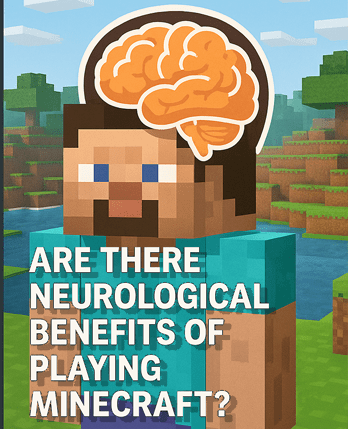
Minecraft is more than just a game – it’s a digital frontier where creativity, strategy, and collaboration thrive. But beyond its entertainment value, what does science say about its impact on the brain? Research shows that playing Minecraft offers substantial cognitive benefits, from honing spatial reasoning to developing leadership skills. Let’s break down how this sandbox game wires the mind for learning and problem-solving.
Coding and Logical Thinking
Redstone circuits, modding, and command block scripting let players create everything from automatic doors to fully functional computers. This hands-on engagement with programming principles strengthens computational thinking and problem-solving. Studies on game-based learning environments show increased cognitive engagement and logical reasoning development, reinforcing the educational value of these mechanics (arxiv.org).
Creative Design and Visual Processing
With an expansive block palette, players craft entire cities, sculptures, and immersive landscapes, instinctively making choices based on color harmony and contrast. This kind of creative play taps into cognitive flexibility and visual-spatial skills. Research on video games and the brain suggests that engaging in creative digital environments strengthens problem-solving abilities and visual processing (pmc.ncbi.nlm.nih.gov).
Community Management and Social Skills
From organizing large-scale events to running PvP tournaments and collaborative building projects, players learn the art of teamwork, communication, and conflict resolution. A study on collaborative gameplay found that children engaging in cooperative Minecraft sessions developed stronger social interaction skills and problem-solving abilities (news-medical.net).
Spatial Reasoning and 3D Thinking
Designing elaborate structures, underground bases, and mazes requires an intuitive grasp of volume, proportion, and perspective. Research has shown that video games emphasizing spatial manipulation enhance spatial visualization and abstract thinking, skills crucial in fields like architecture, engineering, and design (https://psychcentral.com/news/2013/11/26/video-games-help-boost-social-memory-cognitive-skills).
Navigation and Directional Skills
Whether tracking coordinates, reading maps, or navigating vast procedurally generated worlds, players build a strong sense of direction. Studies link this kind of virtual navigation to hippocampal development, the brain region responsible for memory and spatial orientation. One study even found that Minecraft players performed better on hippocampal-dependent memory tasks, suggesting real-world applications for navigation and memory (pmc.ncbi.nlm.nih.gov).
Problem-Solving and Adaptability
Surviving the night, managing resources, and solving complex in-game puzzles demand flexibility and strategic thinking. Research from Glasgow University found that playing Minecraft improves adaptability and resourcefulness – key skills that translate into academic and professional success (funtech.co.uk).
Attention and Working Memory
Tracking inventory, crafting recipes, and objectives in real-time trains the brain’s working memory and focus. A study by the National Institutes of Health found that children who played video games for three or more hours a day performed better on cognitive tasks involving impulse control and memory (nih.gov).
Cognitive Aging and Brain Health
Minecraft isn’t just for kids – older players can benefit from its mentally stimulating yet low-stress gameplay. Research suggests that video games can mitigate age-related cognitive decline, helping with memory retention and overall brain health (pmc.ncbi.nlm.nih.gov).
Final Thoughts: Why Minecraft is More Than Just a Game
Minecraft isn’t just a way to pass the time – it’s an engine for cognitive growth. Whether improving problem-solving, spatial awareness, or social skills, it offers players a unique way to sharpen their minds while having fun. As research continues to uncover the neurological impact of gaming, one thing is clear: Minecraft stands as one of the best examples of play-driven learning.



 UhVyn
UhVyn 
Leave a comment