
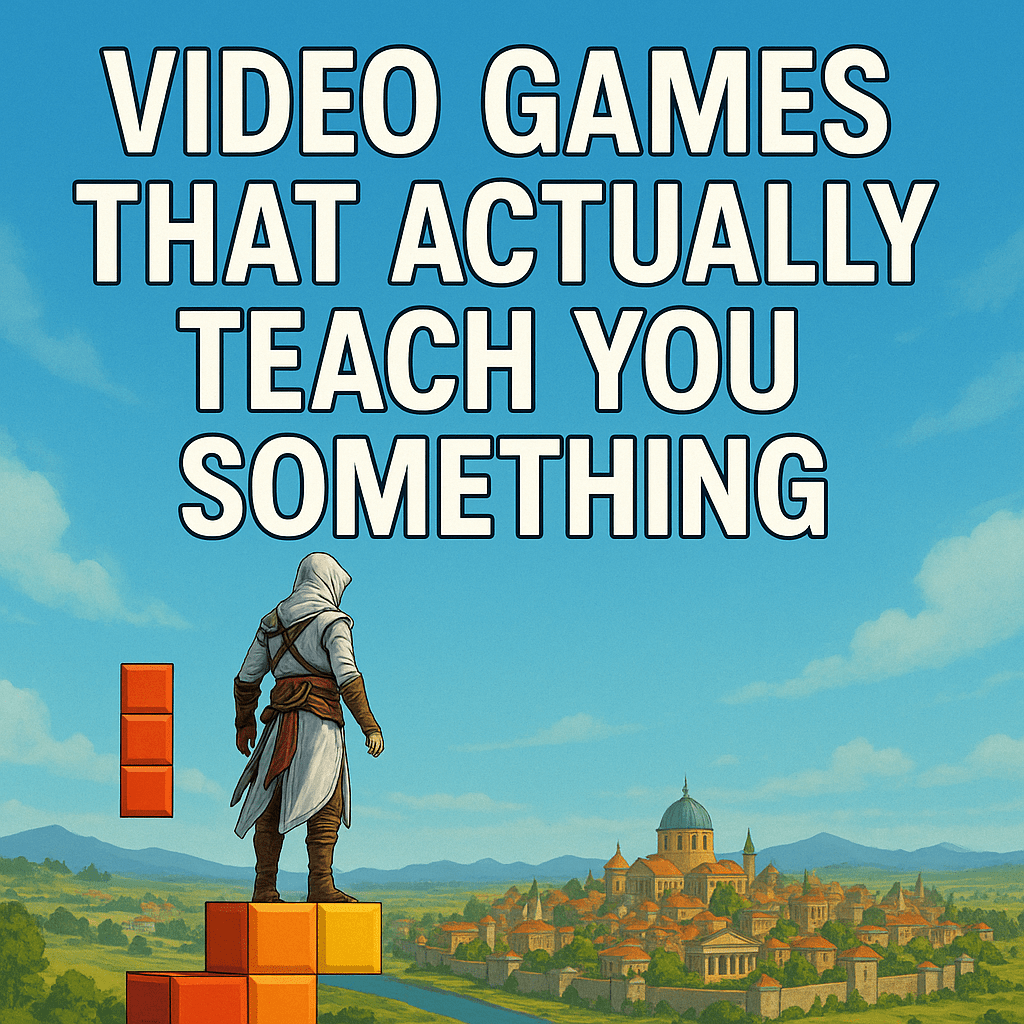
Video games aren’t just mindless fun: some of them can teach you real-world skills and knowledge while you play. Sure, every game hones generic skills like hand-eye coordination or problem-solving, but here we’re talking about games that go a step further. From sneaky history lessons to practical know-how, the following games let you learn while gaming (without feeling like you’re in a classroom). Whether you’re on console, PC, or mobile, these titles are fun first – any learning is an awesome bonus. Let’s dive into some games that actually teach you something in the process of saving kingdoms, building empires, and blasting off into space!
Assassin’s Creed Series – History Comes Alive
The Assassin’s Creed franchise is famous for its richly detailed historical settings. Each game drops you into pivotal eras – from Renaissance Italy to Ancient Egypt – recreated with impressive accuracy. You’ll sneak through real cities and meet figures like Leonardo da Vinci or Cleopatra along the way. In fact, Ubisoft hires historians to ensure authenticity, and players often get inspired to research the real history after playing (abc.net.au) (Who knew a parkour-loving assassin could spark your inner history buff?) While the sci-fi storyline is fictional, the locations, architecture, and many events are real – making Assassin’s Creed a stealthy way to absorb knowledge about the past. If you’ve ever wanted to time-travel and learn something, this series lets you do both from your couch!
Sid Meier’s Civilization – Build Empires & Learn Civics
Ever wondered if you could lead a civilization from the Stone Age to the Space Age? Sid Meier’s Civilization games let you do just that. As you guide a nation through centuries, you’ll bump into real historical leaders, research actual technologies, and make decisions about war, trade, and government. Beyond the history tidbits, Civ teaches broader lessons in diplomacy, economics, and governanceparentingpatch.com. For example, you’ll see how scientific research boosts your society or how poor diplomacy can spark conflicts – insights that map surprisingly well to real-world history and civics. It’s one thing to read about the rise and fall of empires; it’s another to experience it. Just one more turn, and you might accidentally learn why managing an economy or keeping allies matters – both in-game and in real life!
Minecraft – Creativity and Coding in Disguise
A glimpse of the limitless creativity in Minecraft.
Mojang’s Minecraft is often lauded as the ultimate sandbox, and it’s also a fantastic accidental teacher. Sure, it looks like a blocky adventure about punching trees and avoiding creepers, but it flexes your brain in multiple ways. Architecture and design skills? Absolutely – players have recreated real and fictional wonders (one group built King’s Landing from Game of Thrones to scale!). Resource management and planning? You’ll learn to gather materials and budget them for big projects. Most impressively, Minecraft’s redstone system introduces basic engineering and programming logic. When you wire up redstone circuits, you’re basically learning about logic gates and how real computers work. In fact, the game is so effective at sparking creativity and STEM skills that some schools use a special Education Edition. But to any player, it just feels like fun – Minecraft teaches you to think outside the box (literally) while building whatever you can imagine.
Kerbal Space Program – Rocket Science Made Fun
Launching a rocket (and many “learning experiences”) in Kerbal Space Program.
“It’s not rocket science!” doesn’t apply here – in Kerbal Space Program (KSP), it literally is rocket science. This game turns you into the engineer for cute green astronauts (the Kerbals) as they attempt to conquer space. You’ll design rockets and spaceplanes part by part, then test your creations in a realistic physics simulation of orbital mechanics. Don’t be surprised if your early rockets explode spectacularly – failure is a great (and hilarious) teacher in KSP. Over time, you pick up real aerospace concepts like thrust-to-weight ratio, orbital transfers, and why you should always double-check your staging. Players often find themselves learning terms like apoapsis and periapsis, and figuring out how to rendezvous in orbit. Kerbal Space Program teaches you actual physics and engineering principles in the guise of a wacky rocket-building game. Reach orbit (after a few trial-and-error crashes) and you’ll truly feel like a rocket scientist – because in a way, you’ve become one!
Microsoft Flight Simulator – Learn to Fly (Seriously)
If you’ve ever dreamed of piloting a plane, Microsoft Flight Simulator is the next best thing to real flight school. This simulation is so realistic that the world’s geography is recreated from real map data, and the cockpits have every dial and switch you’d find in a real aircraft. You can actually learn the basics of flying a plane, from takeoff to landing, by playing this game. Don’t take our word for it – take the U.S. Navy’s! In one noted case, a young gamer excelled in actual flight training after honing his skills in Flight Simulator, even making the admiral’s list; the military was so impressed they incorporated Microsoft Flight Simulator into their training programs. The game also familiarizes you with world geography as you soar over detailed landscapes and cities. Ever since the 2020 edition, the graphics are so stunning you could use it to virtually sightsee famous landmarks and terrain. For aspiring pilots (or anyone curious how airplanes work), Flight Simulator proves that video games can teach real-life skills – up to and including how to navigate a 747 across the globe.
Rocksmith – Strum Your Way to a New Skill
Remember Guitar Hero? Rocksmith is like that, except you’re using a real guitar and actually learning to play it. This game by Ubisoft turns learning an instrument into an interactive jam session. You plug in any real guitar or bass, and Rocksmith’s software will teach you chords, riffs, and full songs step by step. It’s gamified music practice – hit the right notes in time and you’ll progress, just like leveling up in any other game. Over time, your fingers get used to real fretwork instead of colored buttons. The result: you come away able to play guitar in real life, not just on a screen. Rocksmith includes a vast library of songs in genres from rock to metal to blues, keeping practice fun. It’s even been used by music teachers as a supplement for students. If you’ve always wanted to pick up an instrument but struggled with traditional lessons, Rocksmith might be the most entertaining music teacher you’ll ever have – the skills you learn are 100% transferable off-screen.
Plague Inc. – Pandemic Science and Strategy
Not all learning games wear it on their sleeve – Plague Inc. looks like a darkly comic strategy game where you play as a disease trying to infect the world, but it ends up teaching some serious epidemiology concepts. Starting on mobile and now on PC/console, Plague Inc. became famous for its uncanny parallels to real pandemics. You’ll understand terms like infection rates, vectors of transmission, and R0 (basic reproduction number) as you strategize how a pathogen spreads. The game is so insightful that the Centers for Disease Control (CDC) invited the creator to speak about how Plague Inc. simulates disease outbreaks (ndemiccreations.com). And when COVID-19 hit, the developers even worked with experts to add a mode about stopping an outbreak (Plague Inc: The Cure) to educate people on pandemic responses (who.int). As you play, you unwittingly learn why measures like quarantines, vaccine research, and contact tracing are vital – or how misinformation can hinder disease control. It’s a prime example of a game that’s fun (in a slightly evil way) but also an accidental lesson in public health. Just maybe don’t boast too loudly about how good you are at spreading plagues!
Tetris – Spatial Skills from a Retro Classic
We can’t talk about learning from games without tipping our hat to Tetris, the 1980s puzzle classic. It’s not explicitly about real-world content, but boy, does it train your brain. Those falling blocks (Tetriminos) drill you in spatial reasoning and quick decision-making. After hours of Tetris, don’t be surprised if you start mentally fitting luggage into a trunk with expert precision – many of us owe our packing skills to those cascading blocks. Tetris also teaches adaptability: you’re constantly adjusting your strategy when an L-shape or the long bar piece doesn’t show up on cue. And if you’ve ever entered the fabled “Tetris zone,” you know it improves your focus and mental agility. This simple game has endured for decades not just because it’s fun, but because it gives your brain a hearty workout. It’s the perfect retro pick to prove that even old-school games can teach practical skills (like how to neatly stack anything, anywhere!).
Overcooked – Teamwork Under Pressure in the Kitchen
Ever wondered what it’s like to run a hectic restaurant kitchen? Overcooked serves up that experience in a frantic, family-friendly way. This co-operative game has you and friends/family frantically chopping veggies, cooking dishes, and washing plates in absurd kitchens (on moving trucks, icy floes, you name it). The chaos is hilarious, but it also delivers a crash course in teamwork, time management, and communication. To succeed, you’ll learn to delegate tasks (“You grill the burger, I’ll get the buns!”) and keep calm under pressure when orders pile up. It’s a fun way to realize how much coordination goes into even a simple dinner service – and might just make you appreciate real chefs! Players often report that Overcooked improved their ability to coordinate with others and handle stressful multitasking situations. Plus, if you play with family or a partner, it can teach the real life lesson of clear communication (or else risk burning the soup and setting the kitchen on fire). Who knew a silly cooking game could be such a great teacher?
Stardew Valley – Farming and Finance, Simplified
This charming indie hit is basically a life simulator on a farm, and it sneaks a lot of real-life lessons into its relaxing gameplay. In Stardew Valley, you inherit a run-down farm and gradually turn it into a thriving homestead. Along the way, the game illustrates concepts like basic agriculture (tending crops through seasons), investment and returns (buy seeds now to profit after harvest), and even environmental care (keeping your farm and town clean). As one writer noted, Stardew subtly teaches about investments – you have to spend money on new seeds at the end of each season to keep your farm growing. It also rewards hard work and persistence: your efforts compound over time into a beautiful farm, much like real life. Beyond the farming, you’ll engage in town community projects and build relationships, reinforcing social skills and empathy. The game is so endearing and slow-paced that you absorb these lessons without realizing it. By the time you’ve raised a bumper crop of melons and made friends with the townsfolk, you’ve essentially taken a course in resource management, community, and patience – wrapped in one of the most comforting gaming experiences out there.
Animal Crossing: New Horizons – Community and Money Management
Nintendo’s Animal Crossing: New Horizons is another delightful game that mirrors some real-life skills in a low-stakes setting. You move to a deserted island populated by cute animal villagers and gradually develop it into a bustling community. One of the first things you learn? You have a housing loan to pay off – teaching a lighthearted lesson about mortgages and debt. As you catch bugs, fish, and sell turnips in the “stalk market,” you start to grasp basic economics: buy low, sell high, and save up Bells (the game’s currency) for that next house upgrade. This “stock market” of turnips fluctuates randomly, giving young players a feel for market timing and risk (will prices soar or crash this week?). Animal Crossing also emphasizes resource rationing and community building – you gather wood and materials to build shops and bridges, and you cooperate during events to make the island better. The game runs in real-time, so you learn patience (waiting for that building to finish tomorrow) and routine (daily chores like watering flowers). It’s all very relaxed, but underneath the chill vibes, you’re picking up financial planning, time management, and social skills. Animal Crossing proves you don’t need stress to learn life lessons; sometimes a friendly virtual island is teacher enough.
Game on, learn on! These are just a few examples of video games that combine entertainment with education in clever ways. From history and science to music and money management, games can spark our curiosity and impart knowledge without feeling like school. The next time someone says gaming is a waste of time, you can point out that you’ve learned to fly planes, manage a farm, or even speak a bit of Renaissance Italian (ciao, Ezio!) – all by pressing buttons on a controller. Fun and learning aren’t mutually exclusive, and the best games sneakily prove that by teaching you something new while you’re busy having a blast. So go ahead and enjoy these games guilt-free – you might be leveling up in real life skills without even realizing it!




 UhVyn
UhVyn 
Leave a comment