
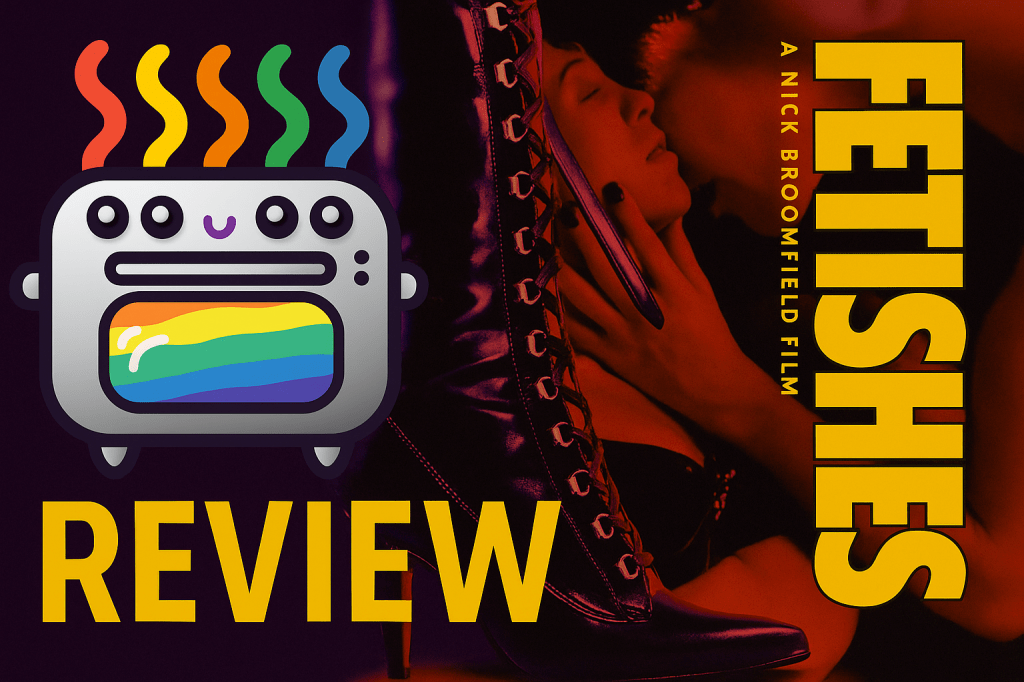
Fetishes is a 1996 documentary by Nick Broomfield that offers a rare, early look into BDSM and fetish communities, a subject seldom seen so candidly on screen at the time. The film is progressive for its era, pulling back the curtain on what was then an underground world. It even opens with vintage Irving Klaw footage of 1950s fetish model Bettie Page in bondage attire, acknowledging that kinky subcultures have long existed even if they stayed in the shadows. Broomfield then takes us into Pandora’s Box – a luxurious Manhattan S&M parlour – to meet the dominatrixes and clients who inhabit this “other” sexual dimension. Many viewers in the ’90s (and even some Rotten Tomatoes commenters today) reacted by calling the film “strange” or “odd,” but the whole point of Fetishes is to show that these desires are more common – and more human – than society admits.
Fetishes Are More Common Than You Think
Watching Fetishes, you can’t help but realize you probably know someone who has a fetish – even if they’ve never told you. For so long, people with kinks have felt compelled to hide in the closet, but Broomfield’s documentary underscores how widespread these proclivities really are. As one audience member reflecting on the film put it, the fetish scene in ’90s New York might have been underground, “Yes. Did everyone know about it? Yes.”. In other words, lots of folks harbor unconventional turn-ons, but stigma keeps them silent. It’s taken us a long time to reach a cultural moment where people can openly accept who they are – foot fetishes, rubber fantasies, domination roleplays and all – let alone openly talk about these things.
Crucially, Fetishes illustrates that what outsiders see as “bizarre” or deviant actually serves a healthy purpose for the people involved. There’s a telling psychological insight early in the film: men who feel powerless in life sometimes hurt others to compensate, whereas men who feel they have too much power will pay to have someone else take command (rogerebert.com). The high-powered Wall Street broker sealed in an airtight rubber suit with a breathing tube, or the stressed executive who gleefully licks a dominatrix’s boots, aren’t “insane” – they’re finding relief. They walk out of sessions drained, relaxed, relieved, at peace (letterboxd.com). What seems odd from the outside is, to them, a therapeutic release from daily pressures and repressed desires. By the end of the documentary, you might agree that these fetishes are “the eroticization of the worst things” in life, flipping fear and stress into something pleasurable as one client observes (filmaffinity.com). Far from being simply “weird,” fetishes often have a relatable logic when you listen without judgment.
Power, Therapy, and Safe Words in Pandora’s Box
One of the most fascinating aspects of Fetishes is how it shows the dominatrixes in a new light; not as mere purveyors of pain, but as caring professionals wielding a unique form of power. The women who work at Pandora’s Box (with fierce names like Mistress Raven, Mistress Delilah, Mistress Natasha and more) exude confidence and control in their latex and leather. They run the show, yet they’re not simply doling out whippings for kicks; they’re effectively performing a therapeutic service for their clients. In fact, the mistresses themselves describe their role as “providing an alternative therapy of sorts” to those who seek them out (web.archive.org). Mistress Raven – who, we learn, was once a Long Island housewife before reinventing herself as New York’s most renowned dominatrix (acmi.net.au) – explains the philosophy behind her dungeon with articulate pride. She’s built a community where people can shed shame and explore fantasies safely.
Inside Pandora’s Box, we see how carefully the dominatrixes and their staff handle each scenario. They consult with clients like counselors might: discussing boundaries, limits, and triggers. A phone call with a submissive client, for example, finds Mistress Beatrice patiently hearing out his foot fetish fantasy – she even promises to send him her worn tennis sneakers via FedEx after her next workout. It’s an almost tender exchange, the mistress acting as a supportive guide (if an unconventional one) to fulfill his needs. Before any session, the mistresses set thresholds for pain or humiliation, and establish safe words to ensure nothing goes beyond what a client can bear. The film underscores that everything is consensual and negotiated – as one participant emphasizes, it’s all valid “as long as [it’s] safe [and] consensual and not sex!” (rottentomatoes.com). In this world, “no” always means no, and a single word can halt the action instantly. That emphasis on safety and consent was eye-opening for many ’90s viewers who had never seen kink depicted as anything but chaos or abuse.
Perhaps most strikingly, the dominatrixes come across as a sort of sexual healers. They talk about the emotional labor involved in dominating: the clients “arrive with tensions and hangups” and effectively transfer their emotional burdens onto the women’s shoulders (rogerebert.com). Mistress Raven admits by closing time she’s often exhausted, having absorbed so much guilt and gloom from the men she’s “treated”. In one poignant scene, she reflects on how much longer she can carry on this work of taking others’ pain. This perspective shows that, for the women, domination isn’t just playful theatrics – it’s hard work and often involves genuine empathy. They must read body language, maintain trust, and sometimes even talk clients through cathartic moments. Fetishes thereby expands our vocabulary of fetishism, revealing dominatrixes as skilled practitioners of a form of intimacy that lies somewhere between role-play, therapy, and theater. And importantly, these women derive their own sense of power and community from the work. As one mistress wryly notes, “it’s kind of nice to be able to beat someone every once in a while” – a cheeky acknowledgement that they, too, get something out of this exchange beyond a paycheck.
Shunned Desires and Finding Acceptance
The clients who walk through the doors of Pandora’s Box are as compelling as the mistresses. Many of them are people you’d never suspect: by day they’re upstanding professionals – lawyers, stockbrokers, police officers – often with spouses and families who have no idea about this side of their lives (thespinningimage.co.uk). Society has long shamed and shunned those with deviant desires, so these individuals learned to hide their fetishes, sometimes for decades. But in the fetish club, they find a judgment-free zone where they no longer have to suppress who they are. Some clients confess that if they didn’t have this outlet, their bottled-up urges might manifest in harmful ways. Watching the film, you get the sense that by indulging in consensual scenes at Pandora’s Box, these folks are actually preventing darker outcomes. It’s a need – a need to accept themselves and know “it’s ok to have fetishes”, as you so aptly put it.
The documentary makes an effort to let clients explain their own kinks in their own words, and the results are eye-opening. We meet men (and a couple of women) who partake in a stunning variety of scenarios, each tailored to their deepest fantasies. Some are relatively familiar fetishes – like a submissive who loves corporal punishment and is scolded for failing a ridiculous task (“You don’t even have control of your most basic muscle,” a mistress taunts as he struggles to perform a hands-free genital trick). Others venture into more intense territory. Broomfield doesn’t shy away from showing the infamous “toilet bowl” scene, where a client literally licks a dirty toilet clean with his tongue as the domme informs him how much “action” that bowl has seen today. It’s a shocking moment that tests viewers’ limits, yet the man clearly wants this degradation – afterwards he is gratified in a way only he might understand. The film mixes such grotesque or humorous vignettes with more sobering ones. For instance, one soft-spoken woman who calls herself a “professional masochist” allows herself to be severely beaten on camera. It’s hard to watch, and even the documentarian’s trademark irony fades in this disturbing session. In these moments, Fetishes forces us to confront the extremes of human desire without offering easy answers. Why would someone want to be hurt so badly? The film wisely doesn’t judge; it just lets the question hang, nudging us to empathize even if we can’t fully relate.
One of the most fascinating (and challenging) aspects of Fetishes is how it delves into socio-political fetishes – fantasies that explicitly reenact power, race, or gender dynamics from real life. We see Jewish clients who pay to be ritually “degraded” by a dominatrix playing a Nazi officer, complete with swastika imagery. We meet a Black man who requests a plantation slave scenario, and a white police officer who asks to be treated like a Black prisoner in custody. These scenes are deeply uncomfortable, yet they’re incredibly revealing. They suggest that some people use fetish role-play to grapple with personal or historical trauma in a way that paradoxically turns pain into pleasure. It’s as if they are reclaiming power over the very narratives that oppress or haunt them. “Fetishes are the eroticization of the worst thing you can imagine,” one client in the film observes, explaining why he seeks out such a scenario (filmaffinity.com). Indeed, by eroticizing the trauma, he feels he can control it. That doesn’t make it any less troubling to witness – even the film’s reviewers wondered “why would [someone] want to put themselves in that position when unsavoury individuals would do that to them in real life?” – but it does humanize the impulse. These clients aren’t crazy; they’re coping. In the dungeon, they’ve found a bizarre yet effective way to exorcise demons that society gives them no healthy way to discuss. For once, they aren’t alone with their secret shame. The dominatrixes don’t bat an eye at even the most taboo roleplays, and that acceptance can be profoundly healing. By the film’s end, you really feel for these customers: after a lifetime of being judged or ostracized, here they are finally free to be themselves.
Broomfield’s Male Lens on an Esoteric World
Stylistically, Fetishes is classic Nick Broomfield – a fly-on-the-wall documentary with the filmmaker occasionally bumbling into frame holding a boom mic. In 1996, bringing a camera crew into a high-class S&M house was virtually unheard of, so credit to Broomfield for having the guts (and luck) to gain access. He spent eight weeks living in this den of dominatrices, filming real sessions (yes, the welts and whippings are 100% real as we see from the raw marks on clients’ skin). At the time, most people only heard jokes about dungeons on late-night TV – nobody had seen this kind of graphic detail on screen. The documentary was made for HBO, but even HBO found it “probably too hot for many of its markets” in the ’90s(brightlightsfilm.com). In that sense, Fetishes was groundbreaking: it dared to show an “other sexual dimension” in unflinching detail, demystifying what goes on behind those closed dungeon doors.
That said, Broomfield’s perspective as a straight man sometimes shows through, for better or worse. He approaches Pandora’s Box as an outsider trying to understand a subculture, and while he is generally respectful, he also can’t hide a certain awkwardness and curiosity that border on intrusive. At times he asks rather misplaced questions – even the mistresses roll their eyes or smirk at him. In one cringe-inducing moment, Broomfield interviews a female client while she’s literally strung up and being spanked, and he awkwardly inquires whether she “does [her] dominatrix’s shopping”. It’s a bizarre, somewhat tone-deaf question that seems to arise from his own male assumptions, and it feels like he included this nude female sub mostly to titillate male viewers. Throughout the film, he often interrupts his subjects and prods them with naive questions, as some critics have noted (letterboxd.com). You can sense his discomfort at times – for instance, the mistresses playfully tease him, trying to lure him into a session, but he “has no difficulty refusing” their offers. The Chicago Reader wryly pointed out that despite his insistence on penetrating this inner sanctum, Broomfield “never has enough nerve or imagination to join in the role-playing” himself(rottentomatoes.com). In other words, he keeps a journalistic distance, perhaps too much distance to fully get the kink experience.
Yet, Broomfield’s detachment is also what gives the doc its candid, matter-of-fact tone. He’s not there to arouse himself or the audience; he’s genuinely documenting. Some viewers appreciate that he doesn’t sneer or roll his eyes at the participants, he lets them speak and treats everyone with a baseline of respect. By the end, he even shows a touch of empathy for Mistress Raven, as she admits to her fatigue and doubts. So while the film might scratch only the surface of fetish culture (focusing mostly on flashy S&M scenarios and not, say, the deeper psychological or community aspects in great depth), it was nonetheless an important first step. It opened the door for conversation. Broomfield’s style may be a bit “pedestrian” and voyeuristic (one reviewer quipped that it can feel like a YouTuber’s vlog in a sex dungeon), but in 1996 this was novel stuff. Simply documenting this esoteric world without sensationalizing it as horror was itself novel. And for many kinky folks at the time, seeing their world on screen – flaws and all – was validating.
Kink Representation: From 1996 to Today
It’s worth noting how far we’ve come since Fetishes debuted. In the mid-90s, BDSM and fetish communities were still largely in the shadows, stigmatized by society and pathologized by medicine. Back then, participating in S&M could brand you as mentally ill or get you arrested under obscenity laws. In fact, just a few years before this film, the UK prosecuted a group of men in the infamous Operation Spanner case simply for engaging in consensual BDSM in private. Representation was scarce – outside of underground magazines or fetish conventions, there were very few honest depictions of kink. Fetishes arrived at a tipping point: by shining a light on Pandora’s Box, it signaled that the world was slowly ready to start talking about these “taboo” practices.
Since then, we’ve seen significant developments and movements toward acceptance of kink. In 1997 – tellingly, just one year after this documentary – a national advocacy group called the National Coalition for Sexual Freedom (NCSF) was founded in the U.S. to defend the rights of consenting adults in the BDSM/leather/fetish community (en.wikipedia.org). Activists like Susan Wright (the NCSF founder) worked tirelessly to educate the public and fight against the idea that fetishes are something shameful or dangerous. Over the decades, their efforts paid off. Medical and psychiatric authorities gradually shifted their stance: the latest Diagnostic and Statistical Manual of Mental Disorders (DSM-5, released in 2013) explicitly excludes consensual BDSM practices from being labeled as disorders so long as they cause no harm or distress (DSM5.org). And in 2018, the World Health Organization’s ICD-11 went even further, removing BDSM-related diagnoses entirely and noting that discrimination against people with fetishes is inconsistent with human rights principles. In plain terms, being kinky is no longer automatically seen as a sickness – it’s recognized as a natural part of human sexual variation.
On the cultural front, kink has seeped into the mainstream consciousness in ways Nick Broomfield probably couldn’t have imagined in 1996. The 21st century brought us everything from Fifty Shades of Grey becoming a household name (for better or worse) to popular TV series featuring BDSM storylines, to celebrities candidly discussing their kinks in interviews. There’s more educational resources and community now too, online forums and fetlife-type networks where kinksters can connect, as well as workshops at sex-positive centers teaching about consent and safe play. Even Pride parades today often include leather and BDSM groups marching openly, reflecting a long-standing overlap between queer liberation and kink communities. None of this is to say the battle for acceptance is over – stigma still exists, and misconceptions (fueled by media like Fifty Shades, which many criticize as an inaccurate portrayal) persist. But compared to the era when Fetishes was filmed, there’s a far broader understanding that fetishism and BDSM can be a healthy form of self-expression for consenting adults. Terms like “safe word,” “aftercare,” and “consensual non-consent” have entered public discussion, whereas 30 years ago they’d have drawn blank stares.
It’s interesting to reflect that Fetishes now stands as a time capsule of a specific moment in kink history. The film captures Pandora’s Box and the New York fetish scene in the mid-90s, when it was both hidden yet surprisingly vibrant (“historic time of the underground everyone knew about,” as one viewer said (rottentomatoes.com)). Watching it today, you might chuckle at the dated fashion (ah, the latex bodysuits and ’90s hair!) or the clunky camera work, but you also appreciate how it helped normalize conversations about BDSM. It showed that fetishists aren’t monsters, they’re teachers, cops, moms, dads, perfectly average people with a kinky twist. That message has only grown stronger in the years since, thanks to community advocacy and greater queer and sexual visibility.
Conclusion: Listening Without Judgment
In the end, what makes Fetishes (1996) a compelling watch is its underlying plea for understanding. By peering into this dungeon, the film asks us to reconsider our snap judgments about those who indulge in kinks. Yes, some scenes will make you wince or gasp. You’ll probably find a few fetishes depicted to be way outside your comfort zone. But if you, as the viewer, resist the urge to ridicule or condemn, you’ll see the humanity in these people. They are seeking connection, catharsis, and yes, pleasure, not so different from anyone else, just arrived at through a nontraditional route. The documentary’s thesis is essentially that kinky people are far more caring and “normal” than the hostile social stereotypes would have you think. The mistresses laugh, empathize, and enforce rules of consent; the clients say “thank you” at the end of a beating and walk away smiling. There’s a sense of community and mutual respect in this supposedly dark underworld.
By shedding light on this reality, Fetishes helps reduce the dangers and stigma that thrive in ignorance. The more we know about BDSM practices, the less likely people will be harmed by them (or by the fear of them). As you eloquently summed up: by having a documentary like this and showing how these people are – showing that kink people are common and caring – we encourage love and acceptance. The film ultimately urges the audience to approach fetishes the way the dominatrixes approach their clients: with open ears and without scorn. Just listen. Listen to why someone might need to submit, or dominate, or role-play a childhood nightmare. You might not share their fetish, but you may find empathy for their experience. In a world still learning how to talk about sex in an honest, healthy way, Fetishes remains a conversation starter. It’s a reminder that understanding is the antidote to prejudice. After all the whips, chains, and outrageous scenarios, the takeaway is surprisingly wholesome: accept people for who they are. Embrace the idea that consensual kink can be part of a well-adjusted life. And above all, remember that everyone has something that lights up their desire – even if it looks “strange” to others – and that’s okay. In 1996, this documentary’s message was ahead of its time. Today, it’s one we continue to champion, louder than ever:
Kink is okay. Just listen, and you’ll hear the humanity in it.





 UhVyn
UhVyn 
Leave a comment