
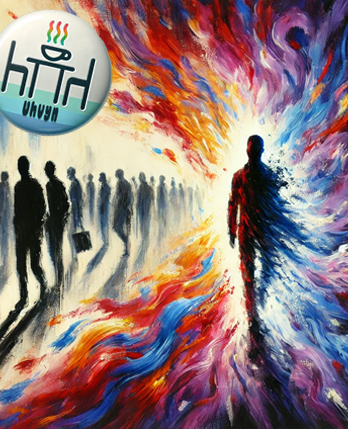
Knowing who you are – truly and deeply – isn’t just a personal journey; it’s a social act. It shapes how you move through the world, how people treat you, and, unfortunately, whether you become a target.
Gender and sexual identity aren’t just abstract concepts. They affect your safety, your mental health, your relationships, and the way society either uplifts or suppresses you. And yet, despite all the conversations, all the visibility, all the “love is love” slogans slapped onto corporate logos every June – identity remains a risky thing to claim.
So let’s talk about it.
Identity & Risk: The Price of Being Seen
At some point, most queer people face the moment where you realize that simply existing as yourself can be dangerous. Maybe it’s the first time someone slurs at you in the street. Maybe it’s hearing lawmakers debate whether you should have rights. Maybe it’s the exhaustion of deciding where you can hold your partner’s hand without weighing the potential fallout.
For many of us, safety isn’t a given. It’s a calculation.
And that’s why identity matters. It’s not just some internal, feel-good self-discovery exercise. It’s about survival. It’s about whether you’re allowed to move through the world with the same level of safety, dignity, and respect as everyone else. And right now? We’re still fighting for that.
Why Identity is More Than a Label
Some folks hear “identity” and immediately roll their eyes. Why does everything have to be about labels? Why can’t people just be people?
Labels aren’t the problem. Labels exist because they help us name experiences, find community, and push back against a world that prefers to pretend we don’t exist. The issue isn’t identity. The issue is how the world reacts to it.
Queerness challenges norms. It disrupts expectations. It forces society to confront the fact that gender and sexuality are more complex than the neat little boxes they were assigned. And some people really don’t like that.
Which is why being openly queer is often framed as “political,” even though cishet people flaunt their identities every day without issue. Straight couples kiss in public, gendered expectations are baked into everything from toys to job applications, and no one calls that an agenda.
But queer people? We’re seen as making a statement just by existing. Just existing is political contention. “I don’t care what you are” is a common response I hear, and I just have to ask: when you’re aware of how much hatred and vilification people experience, why is it bad to choose to care?
And that’s why identity is powerful. Because the simple act of living authentically becomes an act of resistance.
Mental Health & The Cost of Hiding
Living in the closet isn’t just about secrecy – it’s about constant self-editing. It’s filtering every interaction, second-guessing whether a space is safe, and carrying an invisible weight that other people don’t have to think about.
And it takes a toll.
Queer people who feel accepted and affirmed tend to have higher levels of happiness, self-esteem, and life satisfaction. Meanwhile, those forced to hide their identity face increased rates of anxiety, depression, and even physical health issues.
Because when being yourself is framed as a risk, it doesn’t just affect how you act-it affects how you feel. And when we talk about “safe spaces,” we’re not asking for special treatment. We’re asking for the ability to exist without having to brace for impact.
Visibility: Progress, But at a Cost
Queerness is more visible than ever. We’ve got more LGBTQ+ characters in media, more queer people in leadership roles, and more conversations happening in public spaces.
And yet, with every step forward, there’s backlash.
Every time there’s a major win – same-sex marriage legalization, non-binary gender markers, trans healthcare access – there’s a surge of resistance. Hate crimes spike. Anti-LGBTQ+ laws get proposed. People panic about “protecting children” as if queer people simply existing is some kind of dangerous contagion.
Visibility is a double-edged sword. On one hand, it normalizes queerness and offers representation that past generations didn’t have. On the other, it makes us more of a target.
But here’s the thing: visibility was never going to be enough.
It’s not just about being seen. It’s about being respected. It’s about not having our rights treated like a debate topic. It’s about ensuring that visibility doesn’t just mean exposure – it means safety.
The Bottom Line: Identity is a Human Right
At the end of the day, identity isn’t just a personal matter – it’s a social one. It’s about whether people can live without fear, without shame, without constantly having to justify their existence.
And we’re not there yet.
Which means the work – the conversations, the policy changes, the cultural shifts – goes on.
Because the goal isn’t just tolerance. It’s actual acceptance.
And honestly? The world is far more interesting when people get to be who they are.
Citations:
- Mental Health Disparities: Studies consistently reveal alarming mental health disparities between LGBTQ individuals and their heterosexual counterparts. Elevated rates of mood disorders, substance abuse, and self-harm underscore the urgent need for targeted mental health interventions. journals.lww.com
- Increased Hate Crimes: For the second year in a row, more than 1 in 5 of any type of hate crime is now motivated by anti-LGBTQ+ bias. hrc.org
- Mental Health Services Utilization: LGBTQ+ individuals are at particular risk for experiencing shame, fear, discrimination, and adverse and traumatic events. mhanational.org
- Impact of Visibility on Hate Crimes: Visibility is crucial to the argument that LGBTQ+ people are threatening to social norms surrounding sex, leading to increased hate crimes. oxfordre.com
- Mental Health in Transgender Individuals: The percentage of transgender and gender diverse adults experiencing frequent mental distress more than doubled from 18.8 percent in 2014 to 38.9 percent in 2022. hms.harvard.edu
- Online Safety for LGBTQ+ Youth: A new study by Hopelab and Born This Way Foundation highlights that LGBTQ+ youth feel safer and more supported online than in physical spaces, as they explore their identities and seek community. parents.com
- Challenges for Transgender Youth: Families with transgender children are fighting for access to critical healthcare amidst a wave of state and federal bans on gender-affirming care.





 UhVyn
UhVyn 
Leave a comment